
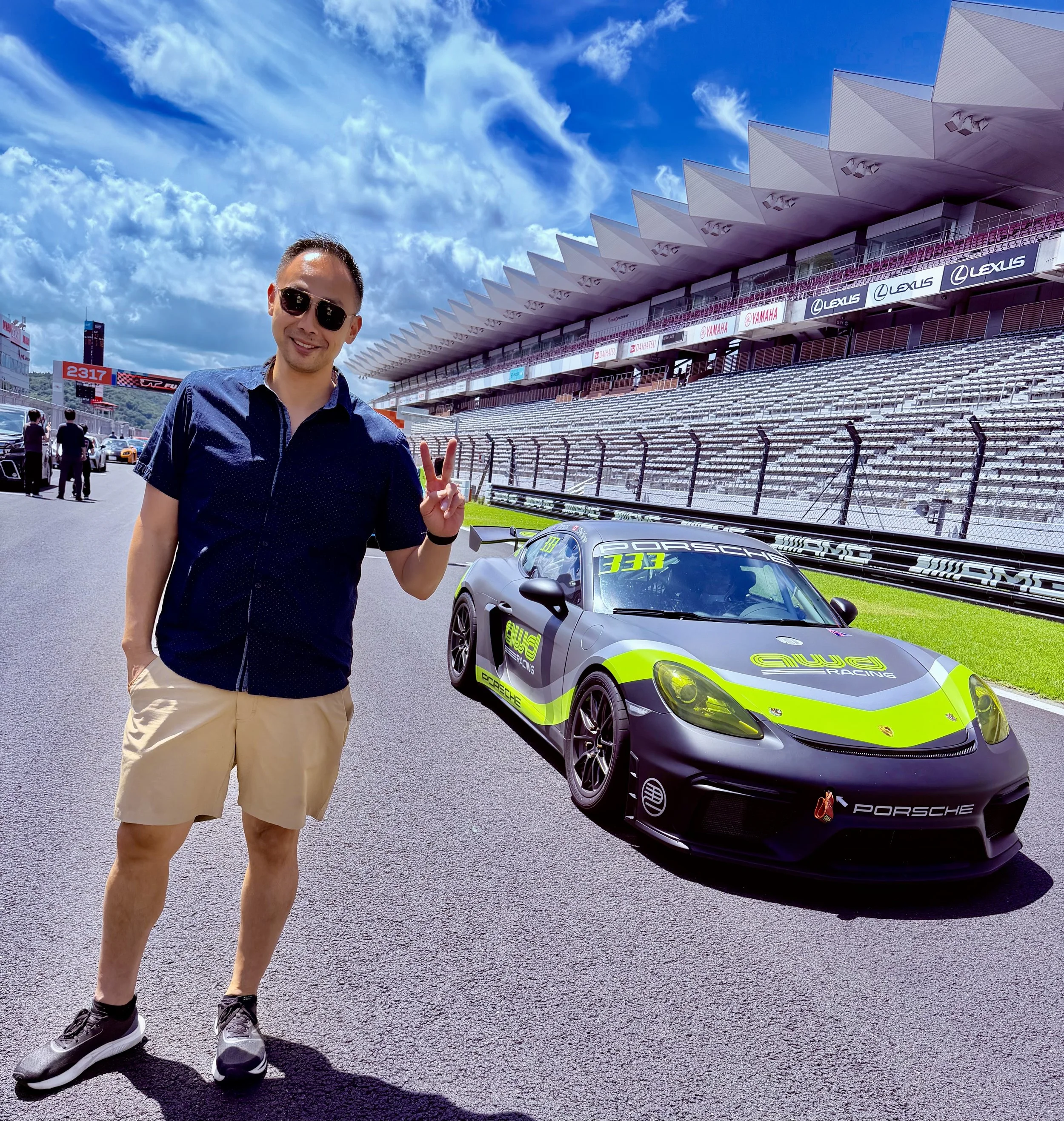
There are certain racetracks where just seeing the front gate gives you a little jolt.
Fuji Speedway is one of them.
Sitting in the shadow of Mt. Fuji, this is one of Japan’s most famous circuits, a place associated with Formula 1, Super GT, endurance racing and decades of Japanese motorsport history.
But I wasn’t there to race.
I was there for something much slower, much more relaxed and, in a very Japanese way, incredibly cool.
Driving the Actual Fuji Speedway Circuit
Fuji Speedway offers an experience where regular drivers can bring their own cars onto the International Racing Course and follow a pace car around the circuit.
No passing.
No attacking corners.
No pretending you're Max Verstappen going into Turn 1.
You simply drive several laps around Fuji Speedway and enjoy the fact that you are actually driving on Fuji Speedway.
And I think the slower pace actually made the experience better.
Instead of concentrating entirely on braking points and lap times, I could look around. I could see the pit buildings, the grandstands, the corners and that famous front straight from the perspective of the driver's seat.
You're getting a chance to experience the architecture of the racetrack rather than race it.
Then Everyone Parks on the Starting Grid
The version I participated in included something I didn't expect to enjoy quite as much as I did.
After driving the circuit, everyone parks their cars together on the starting grid.
Then you get out.
And everybody starts taking pictures.
Lots of pictures.
😂
Cars lined up on the Fuji Speedway grid. Owners walking around with phones and cameras. People crouching down to find exactly the right angle. Friends taking pictures of each other standing beside their cars.
And here's what I found fascinating:
It wasn't only exotic cars.
There were normal cars.
Japanese daily drivers.
Modified cars.
Sports cars.
JDM cars.
European cars.
Expensive cars.
Inexpensive cars.
It really didn't seem to matter.
If it was your car, it deserved a photo at Fuji Speedway.
Japan's Car Photography Culture
This was one of those little cultural observations about Japan that I ended up loving.
Japanese car culture seems to have a very strong connection between cars, place and photography.
The car isn't simply transportation.
It becomes part of the picture.
You'll see people carefully positioning their cars with Mt. Fuji behind them, underneath interesting architecture, at highway rest areas, in parking structures or next to other cars at a meet.
And nobody seems to think it's strange.
In America, if I spent fifteen minutes moving my car six feet forward and three feet backward to get the perfect photograph, somebody would eventually ask me if the car had broken down.
In Japan?
Someone next to me would probably be doing exactly the same thing.
And I kind of love that.
It Doesn't Have to Be a Ferrari
That's what made the Fuji experience particularly interesting to me.
I spend a lot of time around Ferraris, Lamborghinis, Aston Martins and other exotic cars, so it's easy to assume that automotive experiences have to revolve around something rare or expensive.
Japan reminded me that the enthusiasm can be much simpler.
Maybe you have a Toyota.
Maybe you have a Mazda.
Maybe you have an old Nissan you've spent years modifying.
Maybe you've got a Porsche.
Maybe you showed up in the car you drive to work every morning.
When you pull onto the Fuji Speedway starting grid, your car suddenly becomes special because of where it is.
That's the photograph.
That's the memory.
The Famous Fuji Straight, At a Very Civilized Speed
Fuji's front straight is enormous.
Watching it on television doesn't really communicate the scale of it.
Driving down it does.
Even at a relatively slow speed, you're looking down this huge strip of asphalt imagining Super GT cars blasting past the pits and diving into Turn 1.
Except we're all cruising along politely behind the pace car.
Very Japanese.
Very orderly.
And honestly, still incredibly fun.
Sometimes the Experience Isn't About Speed
That's what I took away from the day.
I love driving fast cars.
I love racetracks.
I love the noise, speed and adrenaline that comes with motorsport.
But automotive travel doesn't always have to be about how quickly you can get somewhere.
Sometimes it's about access.
Driving onto Fuji Speedway.
Seeing the track from behind the wheel.
Parking on the starting grid.
Getting out of the car.
Standing there for a moment.
And naturally...
taking about 47 photographs.
Because apparently that's what you do in Japan.
And after spending some time around Japanese car culture, I'm starting to understand why.
The car is part of the journey.
The location is part of the story.
And the photograph is how you remember both.